Companies are investing millions in burnout prevention, employee resilience, and mental health. But what if an overlooked women’s health issue is undermining those investments?
Organizations have spent years trying to solve employee burnout. They've expanded mental health benefits, introduced resilience training, invested in employee assistance programs, offered flexible schedules, and launched initiatives designed to help employees manage stress and improve their well-being.
And for good reason. Burnout is a legitimate workforce concern with implications for productivity, employee engagement, absenteeism, and retention.
But there is a question that deserves a place in every HR and executive leadership conversation.
What if some of the women your organization is trying to help with burnout aren't experiencing burnout alone?
What if the exhaustion, difficulty concentrating, disrupted sleep, anxiety, declining confidence, and changes in performance that look like burnout are actually being influenced by something your wellness strategy has never addressed?
Midlife women's health.
This is not about choosing between burnout and menopause. It's about recognizing that the two can overlap, interact, and sometimes be mistaken for one another.
And when organizations fail to recognize that connection, they may be investing in solutions that address only part of the problem.
The Employee Who Suddenly Isn't Herself
Imagine an experienced female employee in her late 40s.
She's been with your organization for 15 years. She's dependable, knowledgeable, respected by her colleagues, and someone leadership has always counted on.
But something has changed.
She's exhausted despite going to bed early. She's having difficulty concentrating during meetings. Tasks that once felt effortless now require more energy. Her patience is shorter. Her confidence is slipping. She's taking more sick days, scheduling medical appointments, and wondering why she no longer feels capable of managing the responsibilities she's handled for years.
Her manager notices the difference.
Maybe she's overwhelmed. Maybe she's burned out. Maybe she needs to take some time off.
HR recommends the employee assistance program, stress management resources, or a conversation about work-life balance.
Those resources may be helpful. But what if they aren't enough?
What if she's experiencing perimenopause, with changing estrogen and progesterone levels contributing to sleep disruption, mood changes, cognitive complaints, and fatigue?
What if she has already visited her healthcare provider, been told her laboratory results are normal, and left without a meaningful explanation for what she's experiencing?
Now she is struggling at work, questioning her professional abilities, and potentially considering leaving a career she once loved.
The organization sees a performance or burnout concern. The employee experiences a health concern. And neither may recognize the connection.
This is where the conversation needs to change.
Burnout and Perimenopause Are Not the Same Thing
The World Health Organization describes burnout as an occupational phenomenon resulting from chronic workplace stress that has not been successfully managed. It is characterized by exhaustion, increased mental distance or cynicism toward work, and reduced professional efficacy.
Perimenopause, on the other hand, is a biological transition during which reproductive hormone patterns begin to change, often years before a woman's final menstrual period.
The distinction matters because the experiences can look remarkably similar.
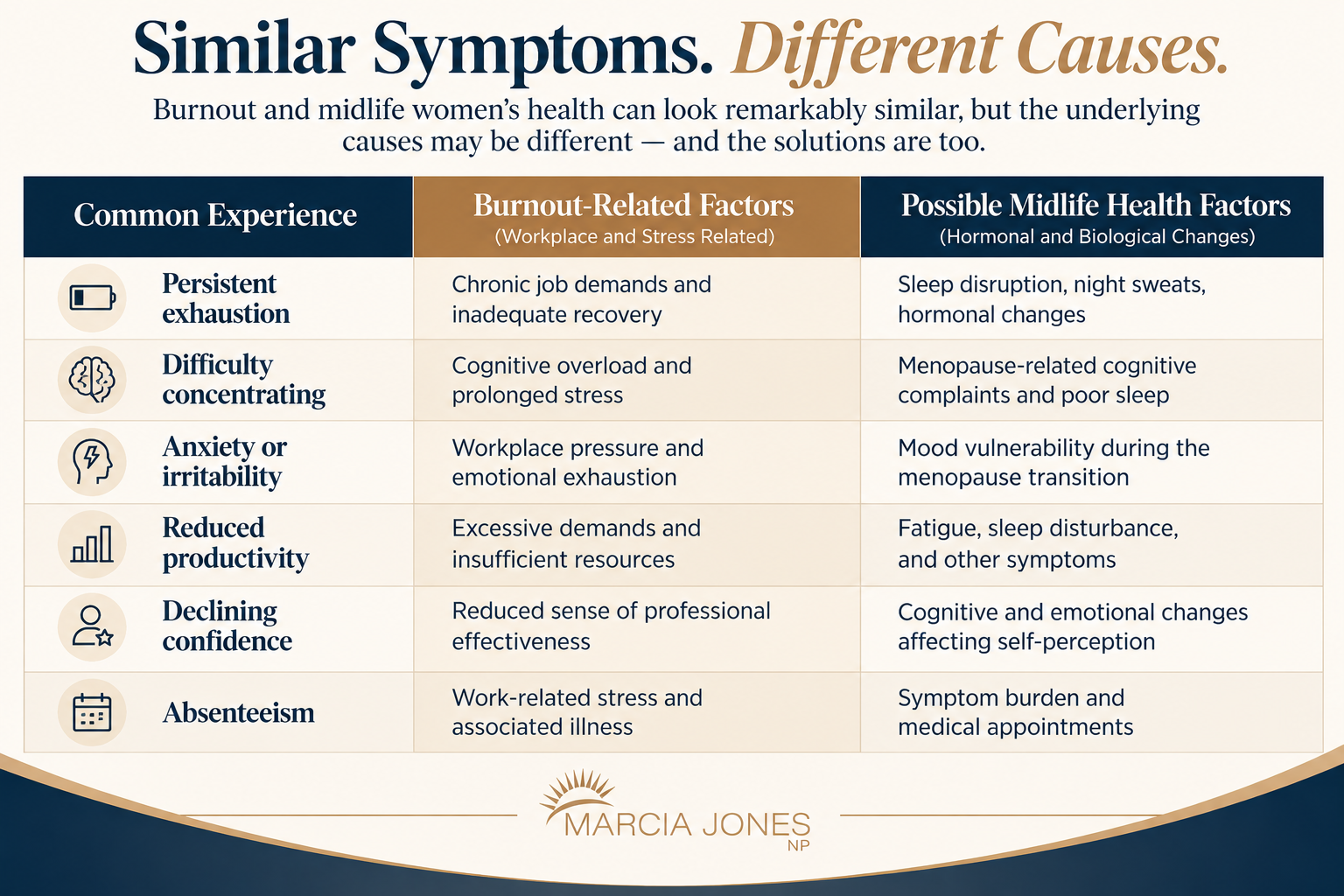
These are not diagnostic distinctions. Symptoms can have multiple causes, including thyroid disease, anemia, depression, sleep disorders, medication effects, and other medical conditions.
Importantly, a woman can be experiencing both occupational burnout and perimenopause at the same time.
The concern is not that organizations are wrong to address burnout. It is that an incomplete understanding of women's health may lead to incomplete solutions.
A mindfulness workshop cannot correct an untreated medical condition. A resilience course cannot eliminate disruptive night sweats. And encouraging an employee to manage stress more effectively does not replace access to knowledgeable healthcare.
Why This Matters to HR and Executive Leadership
Consider the women most likely to be navigating this transition. Many are in their 40s and 50s, a period when they may also be reaching the height of their professional experience and organizational responsibility.
They are department directors, nurses, educators, managers, executives, supervisors, and highly skilled professionals. They are also the employees organizations depend on to mentor younger colleagues, maintain institutional knowledge, make complex decisions, and lead teams through change.
When these women begin struggling, the implications can extend well beyond individual well-being.
1. Productivity Can Decline Before Anyone Understands Why
An employee who is chronically sleep-deprived or struggling with cognitive symptoms may need additional time to complete tasks, find meetings more difficult, or have less capacity for complex decision-making.
From an organizational perspective, this may appear to be disengagement or reduced performance. Without awareness, the underlying health concern may never enter the conversation.
2. Healthcare Utilization May Increase Without Meaningful Resolution
Women experiencing midlife symptoms may seek care for fatigue, insomnia, anxiety, palpitations, mood changes, or other concerns.
Appropriate medical evaluation is essential. However, when the menopause transition is not considered as part of that evaluation, some women may experience fragmented care, repeated appointments, or treatment that does not fully address their symptoms.
For employers managing healthcare expenditures, this raises an important question: Are existing benefits providing access to clinicians equipped to evaluate the full spectrum of midlife women's health?
3. Experienced Employees May Begin Considering an Exit
An employee who no longer feels capable, confident, or supported may begin questioning whether she can continue in her current role. Some may reduce hours, decline advancement opportunities, change positions, or leave the workforce.
Not every decision is caused by menopause. But menopause-related symptoms can contribute to work difficulties and employment decisions.
For employers, losing an experienced employee means more than filling an empty position. It can mean recruitment expenses, training costs, disrupted teams, and the loss of years of institutional knowledge.
4. Managers May Unintentionally Misinterpret What They See
Managers are often trained to recognize burnout, mental health concerns, and changes in employee performance. Far fewer have been prepared to recognize that midlife health challenges may be part of the picture.
Without appropriate education, managers may interpret changes in concentration, confidence, attendance, or emotional regulation as motivation or performance problems.
This creates an opportunity for HR to improve leadership awareness without asking managers to diagnose employees or intrude into private medical matters.
5. Wellness Investments May Fail to Address an Important Employee Need
Organizations may have robust wellness programs and still leave a significant gap in support for women in midlife.
A company can offer mental health counseling, gym memberships, preventive screenings, and resilience programs while providing little education about perimenopause or access to clinicians with appropriate expertise.
Those existing benefits still matter. But a comprehensive workforce wellness strategy should recognize that women's health needs change across their working lives.
The Missing Piece in Traditional Workplace Wellness
For decades, workplace wellness has focused heavily on general preventive care, physical activity, nutrition, stress reduction, and mental health. These are important foundations.
But women are not simply smaller versions of men, and their health needs cannot always be addressed through a one-size-fits-all wellness model.
The menopause transition may affect sleep, cognition, mood, physical comfort, and quality of life. For some women, these changes significantly affect their experience at work.
Yet the traditional annual wellness visit does not always provide the time, clinical depth, or specialized expertise needed to evaluate these concerns comprehensively.
This is especially important because perimenopause is often a clinical diagnosis based on age, symptoms, menstrual history, and appropriate assessment—not simply a single hormone laboratory result.
Women may be told their results are normal while continuing to experience disruptive symptoms.
That doesn't mean every symptom is caused by hormones, or that hormone therapy is appropriate for every woman. It means women deserve thoughtful evaluation, individualized treatment options, and healthcare professionals who understand this stage of life.
Employers do not need to practice medicine. They need to recognize when their workforce strategy has overlooked a medical reality.
Five Questions Every HR Leader Should Be Asking
Before investing another dollar in a new burnout initiative, consider these questions:
1. Are We Distinguishing Between Occupational Burnout and Health-Related Symptoms?
Organizations should continue evaluating workload, staffing, leadership practices, and workplace culture while recognizing that health factors may contribute to employee difficulties.
2. Do Our Healthcare Benefits Include Meaningful Access to Midlife Women's Health Expertise?
Coverage for an annual exam does not necessarily mean employees can access comprehensive perimenopause and menopause evaluation and management.
3. Are Our Managers Equipped to Have Sensitive, Supportive Conversations?
Managers do not need medical details. They need the skills to listen, avoid assumptions, discuss work-related needs, and connect employees with appropriate resources.
4. Are We Listening to What Women Are Telling Us?
Confidential, voluntary employee feedback can help organizations understand whether existing wellness resources meet the needs of women navigating midlife.
5. Are We Measuring the Right Outcomes?
Participation in a wellness program does not automatically demonstrate improved employee health or organizational performance.
Employee experience, benefit utilization, perceived support, retention trends, and other appropriate measures may offer a more meaningful picture of whether a strategy is working.
The Next Evolution of Workforce Wellness
The solution is not to abandon burnout prevention. Organizations still need to address excessive workloads, inadequate staffing, poor management practices, and workplace cultures that contribute to chronic stress.
But they also need to recognize that improving the employee experience requires understanding the people behind the performance metrics.
That means expanding the conversation beyond traditional wellness to include women's health education, leadership awareness, access to appropriate healthcare, supportive workplace practices, and strategies informed by employee needs.
It means creating an environment where an experienced woman can seek support without fearing that her symptoms will be interpreted as professional weakness.
And it means recognizing that women's health is not a niche benefit. It is a relevant consideration in workforce planning, employee well-being, and organizational sustainability.
What If Burnout Isn't the Whole Story?
Imagine what might change if organizations began recognizing midlife women's health as part of their workforce strategy.
An experienced employee who might otherwise have struggled silently could find the information and healthcare support she needs. A manager who might have interpreted changes as poor performance could instead respond with understanding and appropriate workplace support.
An HR leader who has been searching for ways to strengthen retention and employee satisfaction could identify an overlooked opportunity within existing wellness and benefits programs.
Not every case of burnout is a women's health issue. Not every woman experiences disruptive perimenopause symptoms. And no single program can eliminate every workforce challenge.
But when a substantial part of the workforce is navigating a predictable biological transition, ignoring that reality leaves a gap in how organizations understand and support their employees.
The question isn't whether companies should continue investing in burnout prevention. The question is whether they're addressing the whole problem.
And for organizations that depend on the experience, leadership, and contributions of women in midlife, that is a conversation worth having.
Bringing Women's Health Into Your Workforce Strategy
As a Nurse Practitioner and Women's Health & Workforce Strategist, Marcia Jones helps organizations recognize and address overlooked midlife women's health challenges through executive education, leadership workshops, and the U.N.I.Q.U.E. Woman Workforce Method™.
The goal is to help HR leaders and organizations move beyond traditional wellness approaches toward informed, practical strategies that support employee well-being, leadership awareness, and workforce success.
If your organization is investing in burnout prevention, employee engagement, retention, or workforce wellness, perhaps it's time to explore a connection your current strategy may be missing.
Let's start a conversation about what a women's health workforce strategy could look like for your organization.
Explore Corporate Women's Health & Workforce Solutions
Women's Health. Better Healthcare. Stronger Workplaces.

Marcia Jones, NP is a women’s health expert, author and speaker with more than 30 years in healthcare. She partners with organizations to bring modern women’s health education into the workplace, helping women protect their health and potential through midlife while helping employers strengthen and retain an experienced female workforce.