Six HR Challenges. One Overlooked Connection: Midlife Women's Health
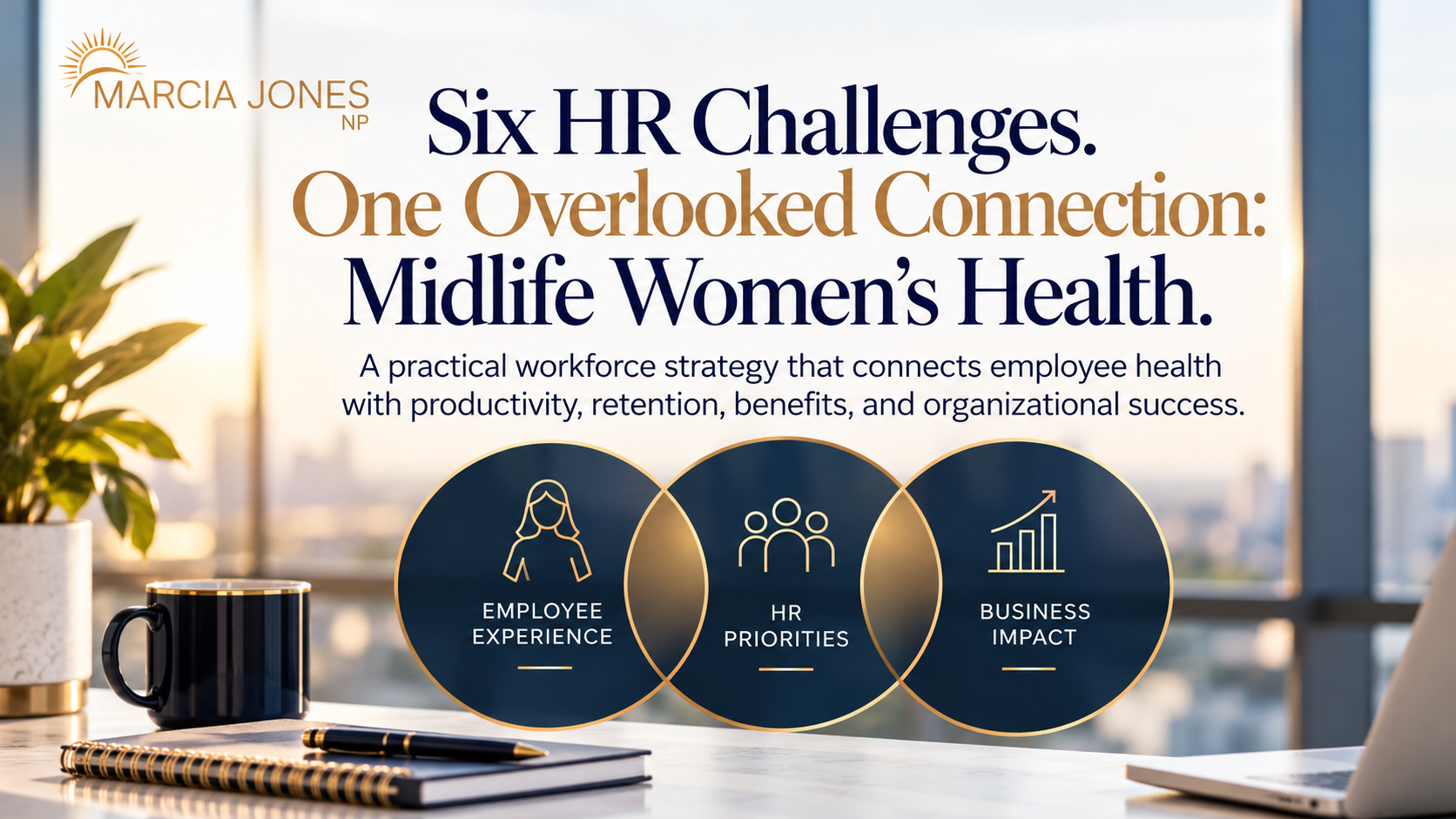
Six HR Challenges. One Overlooked Connection: Midlife Women's Health.
A practical workforce strategy that connects employee health with productivity, retention, benefits, and organizational success.
What if some of the challenges consuming your HR department's time, resources, and budget aren't as unrelated as they appear?
An experienced employee begins struggling with performance. Another needs more flexibility for medical appointments. Benefits utilization is increasing. Engagement is slipping. Managers are navigating sensitive conversations they aren't prepared to have. And retaining experienced talent remains a priority.
Each concern lands somewhere within HR, often requiring a different response, resource, or initiative.
But what if there's a connection nobody has considered?
Women's health in midlife intersects with all six of these challenges. Yet it remains largely absent from traditional workplace wellness strategies and leadership education.
For organizations, this represents more than an opportunity to improve employee well-being. It's an opportunity to rethink how employee health, HR responsibilities, and business performance connect.
And here's the encouraging part: addressing it doesn't necessarily require another expensive benefit, an entirely new wellness program, or more responsibilities for an already stretched HR department.
It begins with understanding what is happening, recognizing where existing resources may be falling short, and preparing your organization to respond more effectively.
To see the opportunity, we first need to look at the same workplace challenge from three very different perspectives.
The Missing Connection
Consider what may be happening inside your organization right now.
The Employee Experience
She's an experienced professional who has spent years building her career. She's dependable, knowledgeable, and accustomed to managing a demanding schedule.
But lately, something feels different.
She's exhausted. Her concentration isn't what it used to be. She's having trouble sleeping, scheduling more medical appointments, and wondering why things that once felt manageable suddenly require so much effort.
She's seeking answers, but her healthcare experience may feel fragmented. One appointment addresses her sleep. Another focuses on fatigue. She's encouraged to manage stress, exercise more, or improve her diet.
Yet nobody seems to be looking at the bigger picture.
And she may not fully understand what's happening herself.
Meanwhile, she's still showing up to work, doing her best to maintain her performance, and hoping nobody notices how much she's struggling.
The HR Experience
Now consider what HR sees.
More appointments. Requests for flexibility. Questions about benefits. Changes in productivity. Perhaps a previously engaged employee who seems less enthusiastic or begins withdrawing from additional responsibilities.
Each issue is addressed individually.
The benefits question goes to Total Rewards. The performance concern goes to her supervisor. The request for flexibility becomes an employee relations matter.
Everyone is doing their job, but nobody necessarily recognizes that these separate concerns may be connected.
And why would they?
Most workplace wellness education has never adequately prepared HR professionals or managers to recognize the broader implications of women's changing health needs during midlife.
The Organizational Experience
Now look at the same situation from the employer's perspective.
Potential productivity loss. Increased healthcare utilization. Employee disengagement. Greater pressure on managers and HR. And possibly the loss of an experienced employee who carries years of institutional knowledge.
Meanwhile, the organization may already be investing significant resources in healthcare benefits, wellness initiatives, employee assistance programs, and retention strategies.
Yet those investments may not be adequately addressing this particular need.
Three perspectives. One overlooked connection.
When organizations begin connecting these experiences, an opportunity emerges to change all three.
When Women Feel Unsupported Everywhere, Everyone Loses
There is another layer to this conversation that deserves attention.
Imagine feeling unlike yourself, struggling to get meaningful answers through healthcare, uncertain whether your benefits will cover the care you need, and uncomfortable discussing any of it at work.
That's a difficult position for any employee.
For women who have spent decades establishing themselves professionally, the fear of appearing less capable can make these conversations particularly sensitive.
She doesn't want to be viewed differently. She doesn't want her age or health to become a question mark over her abilities. And she certainly doesn't want a personal health concern to influence her professional opportunities.
So she stays quiet.
But silence doesn't mean the problem disappears.
It can contribute to frustration, disengagement, reduced confidence, and eventually decisions about whether remaining in that workplace is sustainable.
From a business perspective, losing an experienced employee means potentially losing institutional knowledge, established relationships, leadership capabilities, and the investment made in developing that individual.
What may initially appear to be an individual health challenge can become a much larger organizational concern.
And this is where HR has an opportunity to make a meaningful difference.
Preparing for the Conversations Nobody Taught Us to Have
Let's be clear about something.
HR professionals are not healthcare providers, and managers should never be expected to diagnose an employee's symptoms.
That's not what supporting women's midlife health in the workplace means.
It means understanding that sensitive health conversations require awareness, appropriate boundaries, and a thoughtful response.
Consider an employee who approaches her manager and says, "I just haven't felt like myself lately. I'm having trouble keeping up, and I don't really know why."
Is that manager prepared to respond?
Can they listen without making assumptions? Do they understand the importance of maintaining privacy? Do they know what resources are available or when to involve HR?
Most importantly, can they offer appropriate workplace support without making the employee feel that her professional capabilities are being questioned?
These are skills that can be developed through education.
And preparing managers for these conversations can benefit far more than women experiencing midlife health changes. It helps build a workplace culture where sensitive concerns are handled with greater understanding, professionalism, and respect.
The goal is not to encourage personal medical disclosures.
It's to create an environment where employees can seek appropriate support without fear of embarrassment, judgment, or professional consequences.
What If the Solution Is Simpler Than We Think?
When employers hear about another workplace health priority, the immediate concern is often cost.
Another program? Another benefit? Another initiative for HR to manage?
Not necessarily.
One of the most valuable starting points is examining what the organization already has in place and identifying where awareness, education, or access may be falling short.
For example, women's midlife health education can become part of an existing wellness calendar. Managers can receive practical guidance through established leadership development programs. Benefits teams can review whether current resources are meeting employee needs and whether employees understand how to access them.
Sometimes a small adjustment in how information is presented can make an important difference.
Women may not recognize that seemingly unrelated changes in sleep, energy, concentration, or overall well-being deserve a more comprehensive healthcare conversation.
Appropriate education can help them recognize when to seek qualified medical guidance rather than continuing to manage each concern in isolation.
And employers can provide that education without becoming involved in individual medical decisions.
The opportunity is to connect existing resources more effectively, identify meaningful gaps, and make informed decisions about where additional investment may be warranted.
Six Opportunities for HR to Make a Difference
An integrated women's health strategy can address several existing HR priorities simultaneously.
These opportunities aren't isolated. They reinforce one another.
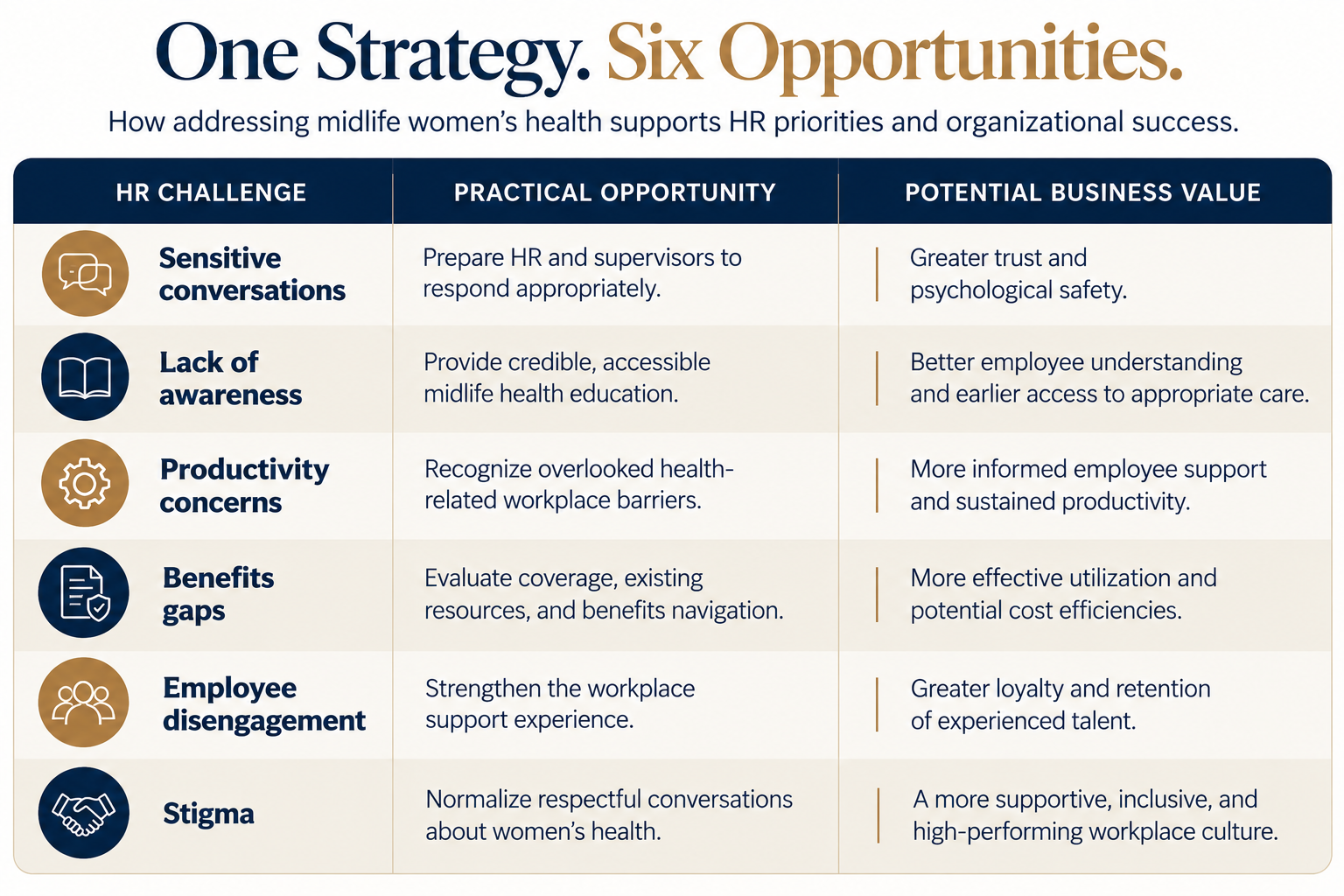
When employees have access to better education, they can make more informed healthcare decisions. When managers are prepared for sensitive conversations, employees may feel more comfortable seeking appropriate workplace support. When HR understands where existing benefits fall short, organizations can make better-informed investments.
And when women feel understood and supported, employers have an opportunity to strengthen the relationship with employees they have already invested years in developing.
The Business Value of Connecting the Dots
Women's midlife health isn't simply another topic to add to the wellness calendar. It intersects with some of the most pressing responsibilities facing HR and organizational leadership.
Consider the potential impact of addressing these issues through a coordinated strategy.
Employee loyalty and retention. Women remember how they were treated when they were struggling. An employer that demonstrates understanding during a challenging season can build trust that extends well beyond that moment.
Workforce performance. Recognizing and addressing unnecessary workplace barriers can help experienced employees continue contributing their knowledge, leadership, and expertise.
Benefits effectiveness. Improving education and navigation can help employees make better use of existing resources while giving organizations greater insight into potential coverage gaps.
Cost management. Earlier awareness, appropriate care navigation, and better-aligned workplace support may create opportunities to reduce avoidable inefficiencies and protect the organization's investment in experienced talent.
Workplace culture. Normalizing respectful conversations helps reduce stigma and reinforces the message that employees are valued throughout every stage of their professional lives.
Of course, these outcomes require thoughtful implementation. Education alone cannot resolve inadequate healthcare access, and not every workplace challenge is related to midlife health.
But when organizations begin addressing employee education, leadership awareness, benefits, and workplace practices together, they create a more meaningful strategy than any one initiative can deliver independently.
The Opportunity to Become the Employer Who Gets It
There is something powerful about an organization recognizing a need that its employees have struggled to articulate.
For the woman who has spent months wondering why she doesn't feel like herself, access to credible information can be an important first step.
For the HR professional managing multiple seemingly unrelated concerns, greater awareness can provide a different perspective.
And for the employer investing in employee engagement, productivity, and retention, understanding these connections can reveal opportunities that have been hiding in plain sight.
This isn't about treating women differently or assuming every woman will experience the same challenges.
It's about ensuring an important area of workforce health is no longer overlooked.
It's about preparing people for sensitive conversations before they become difficult ones.
It's about making existing resources work better, recognizing where gaps remain, and creating a workplace where women don't have to struggle silently to protect their professional standing.
And perhaps most importantly, it's about losing the stigma that has kept these conversations outside the workplace for far too long.
The organizations that get this right won't simply be adding another wellness initiative. They'll be creating a more informed, supportive, and effective workforce strategy.
Because women's health isn't just a healthcare issue.
It's a workforce strategy.
Is Your Organization Connecting the Dots?
I help organizations recognize and address the overlooked challenges of women's midlife health through modern workplace strategies that support employees while strengthening organizational performance.
Through the U.N.I.Q.U.E. Woman Workforce Method™, we bring together practical education, leadership awareness, benefits considerations, and workplace support to help employers move from awareness to meaningful action.
You don't need to turn HR into healthcare providers or start with an expensive new initiative. You need a strategy that connects the employee experience, the HR experience, and the business impact.
Let's explore what that could look like for your organization.
Women’s Health. Modern Healthcare. Stronger Workplaces.
Explore Corporate Women's Health Programs Invite me into the conversation at your organization.

Marcia Jones, NP is a women’s health expert, author and speaker with more than 30 years in healthcare. She partners with organizations to bring modern women’s health education into the workplace, helping women protect their health and potential through midlife while helping employers strengthen and retain an experienced female workforce.