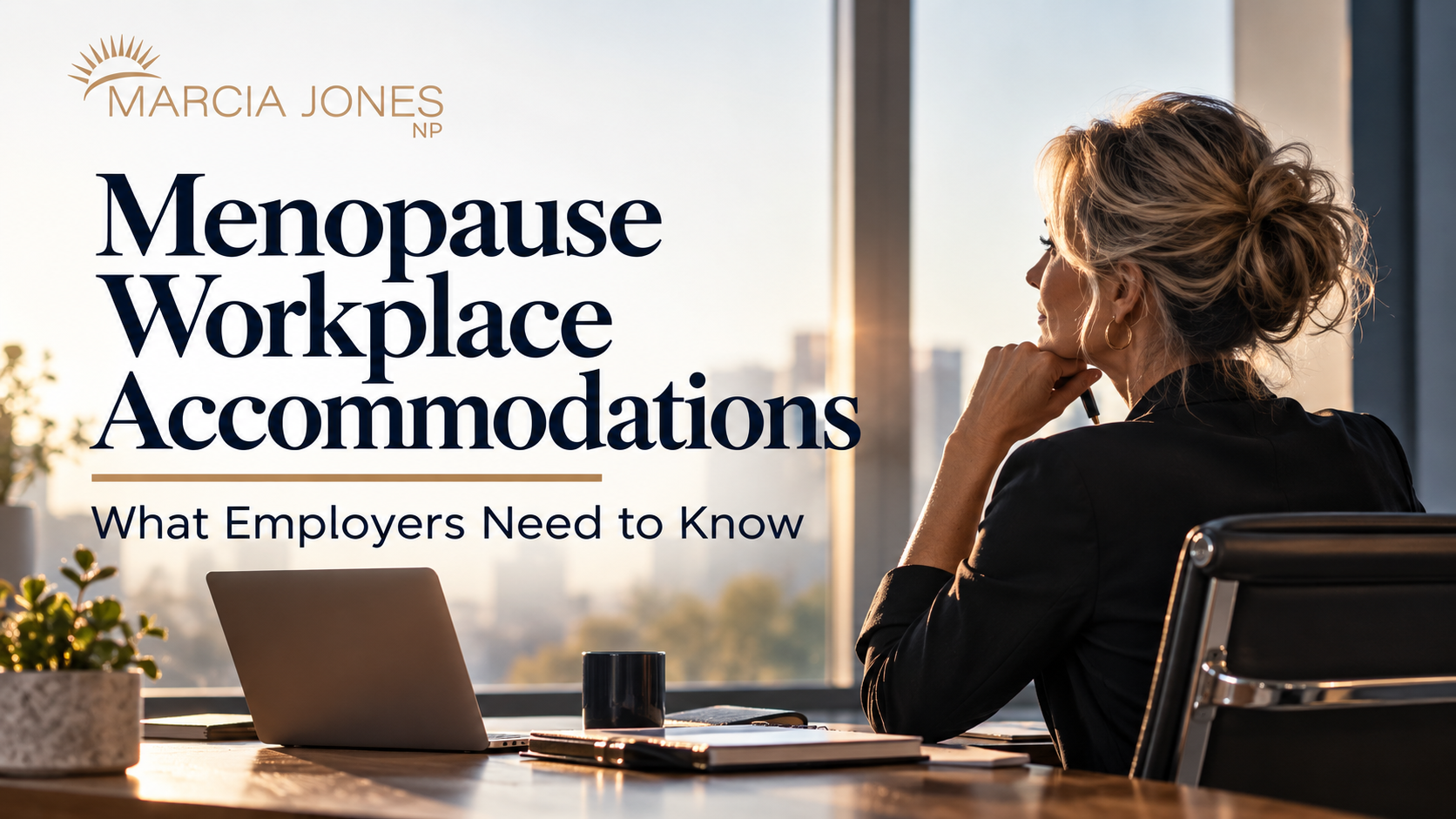
Menopause Workplace Accommodations: What Employers Need to Know
Workplace Accommodations for Midlife Women: A Workforce Strategy Employers Can No Longer Ignore
Supporting women through midlife isn't about special treatment. It's about protecting experience, performance, and the future of your workforce.
For decades, workplace accommodations have largely been discussed in the context of disabilities, pregnancy, physical limitations, and medical recovery. Employers have developed policies, invested in ergonomic workspaces, and introduced flexibility to help employees remain productive while navigating health challenges.
Yet there is another significant health transition affecting millions of working women that has received remarkably little attention in traditional workplace policies: perimenopause and menopause.
Women in their 40s and 50s are often among the most experienced and valuable members of an organization. They lead teams, manage complex responsibilities, mentor younger professionals, and carry years of institutional knowledge. Many are also navigating a period of significant physiological change that can affect sleep, cognitive function, temperature regulation, mood, energy, and overall well-being.
These changes do not diminish a woman's professional capabilities. However, when workplaces fail to recognize or respond to them, the consequences can extend beyond individual discomfort.
They can influence productivity, engagement, absenteeism, career advancement, and ultimately retention.
The question for employers is no longer simply whether menopause belongs in workplace conversations. It is whether existing workplace practices are adequately supporting the women whose experience and leadership organizations cannot afford to lose.
The Hidden Gap in Workplace Accommodations
Traditional workplace wellness programs often emphasize physical activity, preventive screenings, nutrition, and stress management. These initiatives have value, but they frequently overlook the complex hormonal and physiological changes occurring during midlife.
A woman experiencing repeated nighttime awakenings may arrive at work exhausted despite maintaining healthy habits. Another may struggle with temperature regulation in a workspace where environmental controls are limited. A previously confident executive may begin experiencing unpredictable brain fog, anxiety, or difficulty concentrating.
These symptoms are not universal, and their severity varies considerably. For some women, the transition is relatively manageable. For others, symptoms can significantly interfere with daily functioning.
Unfortunately, many women hesitate to discuss these experiences with supervisors or human resources departments.
They may fear being perceived as less capable, less reliable, or less suited for leadership responsibilities. In competitive professional environments, acknowledging a health challenge can feel like putting years of hard-earned credibility at risk.
As a result, women often attempt to manage symptoms privately, even when relatively simple workplace adjustments could make a meaningful difference.
This creates a troubling disconnect: organizations invest heavily in developing and retaining experienced talent while overlooking a predictable life transition that may affect a substantial portion of that workforce.
Accommodations Are Not About Lowering Standards
One of the greatest misconceptions surrounding workplace accommodations is the assumption that supporting an employee's health needs somehow means reducing expectations.
In reality, effective accommodations are designed to help employees meet expectations.
Consider an experienced manager who is experiencing severe sleep disruption related to perimenopause. A modest adjustment to her morning schedule may allow her to perform more effectively without compromising her responsibilities.
An employee experiencing frequent hot flashes may benefit from improved ventilation, access to a fan, or flexibility in workplace attire.
A professional experiencing temporary difficulty concentrating may find that protected periods for focused work or flexibility around demanding meeting schedules improve her productivity.
None of these adjustments requires an employer to abandon performance standards.
They simply recognize that the conditions in which people work can influence how effectively they perform.
Organizations already apply this principle in countless ways, from ergonomic equipment to flexible work arrangements and accommodations for other health conditions.
Midlife women's health deserves thoughtful consideration within that same framework.
What Meaningful Workplace Accommodations Actually Look Like
Supporting midlife women does not necessarily require expensive programs or major operational changes. In many cases, the most effective strategies begin with education, flexibility, and a willingness to evaluate how existing policies affect employees.
The Menopause Society has published consensus recommendations encouraging employers to review workplace policies, healthcare benefits, flexibility, and accommodations for women experiencing menopause-related symptoms.
(PubMed)
Practical examples include:
Flexible scheduling: Adjusted start times, hybrid work options, or scheduling flexibility when sleep disruption and fatigue become significant.
Temperature and environmental adjustments: Access to fans, improved ventilation, breathable uniforms, and temperature-controlled workspaces.
Breaks and physical comfort: Reasonable access to restrooms, hydration, brief recovery periods, and private spaces when symptoms become disruptive.
Support for concentration: Quiet workspaces, protected focus time, and thoughtful scheduling of cognitively demanding tasks.
Healthcare access: Benefits that support evaluation and treatment of perimenopause and menopause, along with reasonable flexibility for medical appointments.
Manager education: Training supervisors to recognize potential workplace barriers, respond professionally, and avoid assumptions about an employee's age, health, or capabilities.
Not every adjustment will be appropriate for every role or organization. A nurse working in an emergency department has different operational responsibilities than an executive working remotely. Effective policies must consider both the employee's needs and the essential functions of the position.
The goal is not to create a single accommodation policy that applies to every woman. It is to establish a consistent, respectful process for identifying practical solutions.
The Legislative Landscape Is Beginning to Change
Employers should also recognize that workplace support for menopause is moving beyond voluntary wellness initiatives and into employment policy.
In 2025, Rhode Island became the first state to explicitly establish workplace protections for menopause and related conditions under its fair employment law. The legislation requires covered employers to consider reasonable accommodations, signaling an important shift in how women's midlife health is recognized in the workplace. (Rhode Island General Assembly)
Illinois has also enacted menopause-related workplace protections scheduled to take effect January 1, 2027. (Venable LLP)
At the federal level, menopause is not automatically considered a disability under the Americans with Disabilities Act. However, severe symptoms may qualify for protection when they meet the applicable legal definition of disability. Employers must evaluate qualifying accommodation requests individually, including whether a proposed adjustment would create undue hardship.
(U.S. Equal Employment Opportunity Commission)
These developments do not mean every employer must implement identical menopause-specific accommodations. Requirements vary by jurisdiction and individual circumstances.
They do, however, reflect a growing recognition that women's midlife health deserves a place in workforce policy discussions.
Forward-thinking organizations should not wait for legislation to begin evaluating their approach.
The Greater Risk May Be Losing Women Who Never Ask for Help
When organizations consider the cost of workplace accommodations, they often focus on the expense of implementing changes.
But what about the cost of doing nothing?
Consider the financial and operational impact when an experienced female leader reduces her responsibilities, declines advancement, or leaves an organization because unmanaged health symptoms have made her work increasingly difficult.
Replacing that employee involves more than recruitment costs. It may mean losing professional relationships, leadership continuity, specialized expertise, institutional knowledge, and the mentorship she provides to others.
And not every woman who struggles will leave.
Some remain in their positions while quietly experiencing declining engagement, reduced confidence, or persistent exhaustion.
These outcomes can be difficult to measure, but they deserve consideration in workforce planning.
The larger business question is whether organizations are creating conditions that allow experienced women to remain healthy, engaged, and productive throughout their careers.
A workplace that makes relatively modest adjustments to retain valuable talent may be making a far more strategic investment than one that overlooks the issue until employees begin leaving.
Why HR and Benefits Leaders Must Look Beyond Accommodations
Workplace adjustments are important, but they are only one component of a comprehensive midlife women's health strategy.
An employer can provide flexible scheduling and temperature-controlled workspaces while still offering healthcare benefits that leave women struggling to access knowledgeable clinicians.
Many women continue to encounter gaps in evaluation and treatment of perimenopause and menopause. Symptoms may be attributed solely to stress, aging, or lifestyle without adequate consideration of hormonal changes, sleep health, metabolic factors, thyroid function, and other contributing conditions.
For employers, this creates an opportunity to examine not only the workplace environment but also the quality and accessibility of healthcare resources available to female employees.
Human resources and benefits leaders should be asking whether their healthcare plans provide meaningful access to menopause-informed care, whether employee education addresses midlife health, and whether managers understand how to respond appropriately when health concerns affect work.
This does not mean employers should diagnose or manage employees' medical conditions. Medical decisions belong between women and their healthcare professionals.
It means organizations can help remove unnecessary barriers to obtaining appropriate care while maintaining privacy, dignity, and professional expectations.
Building a Workplace Where Experienced Women Can Continue to Thrive
Meaningful progress requires moving beyond awareness campaigns and creating an organizational approach that connects women's health with leadership, benefits, employee experience, and retention.
That is the purpose behind my U.N.I.Q.U.E. Woman Workforce Method™, a framework designed to help organizations better understand the overlooked health challenges of midlife and translate that understanding into practical workplace strategies.
Rather than treating menopause as an isolated wellness topic, the framework encourages organizations to examine the broader relationship between women's health, workforce culture, benefits, education, and long-term organizational performance.
For HR and leadership teams, the starting point is not necessarily a new policy or an expensive initiative. It is an honest assessment of whether existing systems adequately support women during a significant phase of their professional and personal lives.
Are employees comfortable requesting assistance? Do managers know how to respond? Are benefits aligned with the health needs of midlife women? Are workplace policies flexible enough to address individual needs without compromising essential business operations?
These questions can reveal opportunities for meaningful improvement.
Most importantly, organizations must recognize that women do not suddenly become less valuable when they enter perimenopause or menopause.
In many cases, they are entering the most influential and professionally experienced years of their careers.
Their health deserves attention, and their contributions deserve protection.
The Future of Workplace Support Is Changing
Workplace accommodations for midlife women should not be viewed as an extraordinary benefit or a concession to declining performance.
They should be understood as one part of a modern workforce strategy that recognizes the relationship between employee health and organizational success.
The employers that lead this conversation will be those willing to challenge outdated assumptions, educate their leadership teams, evaluate existing policies, and recognize that supporting women through midlife is an investment in the strength of their workforce.
Women should not have to choose between managing their health and maintaining their careers. And employers should not have to lose exceptional talent because they failed to recognize an opportunity to provide meaningful support.
The workplace is changing. Women's healthcare is changing.
The organizations that understand how these two conversations intersect will be better positioned to retain experienced women and build stronger workplaces.
Bring This Conversation to Your Organization
Midlife women's health is more than an individual healthcare concern. It is an emerging workforce priority with implications for employee engagement, leadership development, benefits strategy, and retention.
I'm Marcia Jones, NP, and I work with organizations to bring modern women's health strategies into the workplace through education, leadership engagement, and the U.N.I.Q.U.E. Woman Workforce Method™.
If your organization is evaluating how to better support and retain experienced women, I welcome the opportunity to explore what a practical, sustainable approach could look like for your workforce.
Women’s Health. Modern Healthcare. Stronger Workplaces.
Explore Corporate Women's Health Programs Invite me into the conversation at your organization.
Marcia Jones, NP is a women’s health expert, speaker and creator of the U.N.I.Q.U.E. Woman Workforce Method™, helping organizations address the overlooked health challenges of midlife and create workplaces where experienced women can continue to thrive.

Marcia Jones, NP is a women’s health expert, author and speaker with more than 30 years in healthcare. She partners with organizations to bring modern women’s health education into the workplace, helping women protect their health and potential through midlife while helping employers strengthen and retain an experienced female workforce.