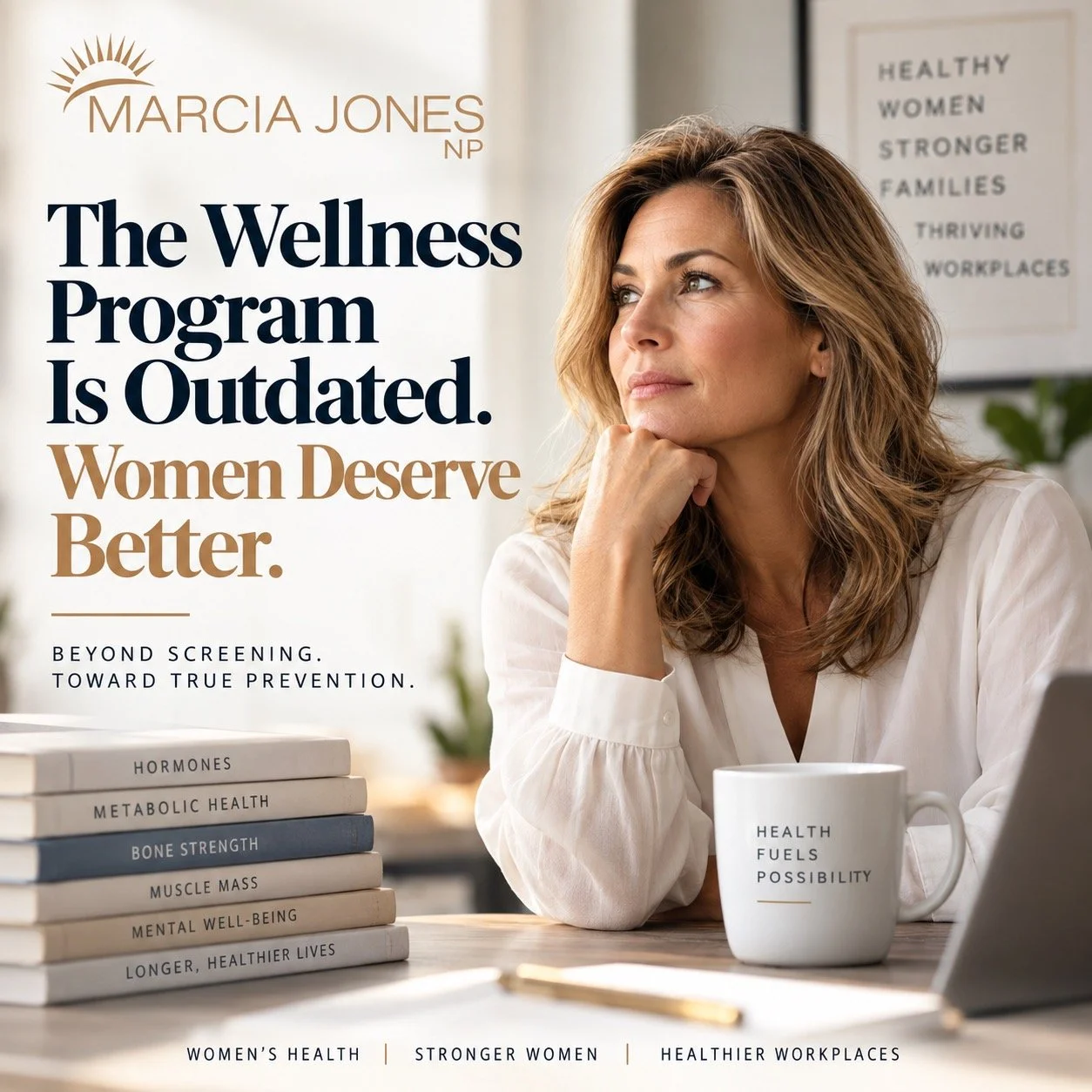
The Wellness Program Is Outdated. Women Deserve Better.
It Is Time to Change the Way We Care for Women
We need to have a serious conversation about what we currently call preventive healthcare for women. The traditional annual wellness exam remains important for identifying disease and established risk, but we have allowed disease screening to become almost synonymous with prevention. A woman has her blood pressure checked, completes a CBC and comprehensive metabolic panel, has her glucose and cholesterol measured, perhaps receives a TSH, and completes the recommended cancer screenings for her age. If nothing significant is identified, she is reassured that everything looks normal and asked to return the following year.
There is value in every one of those measures. The problem is not that we are doing them. The problem is that we have convinced ourselves that this constitutes a comprehensive approach to wellness.
For a woman who feels well and has no significant symptoms, routine preventive screening may provide important reassurance. But consider the woman in her 40s or 50s who arrives at that same appointment exhausted, sleeping poorly, losing muscle, gaining abdominal weight, struggling with concentration, experiencing menstrual changes, noticing changes in sexual health, and saying, “I don't feel like myself anymore.” When her standard laboratory results fall within reference ranges, we have established that certain diseases or abnormalities were not detected. We have not necessarily explained what is happening to her, nor have we developed a meaningful strategy for protecting her health over the decades ahead.
This is where women's healthcare needs to evolve.
Female Physiology Changes Across a Lifetime
Men and women share many of the same health risks, but biologically we are not the same. That distinction should be reflected more intentionally in preventive healthcare. A woman's physiology changes considerably from puberty through the reproductive years, pregnancy and postpartum when applicable, perimenopause, menopause and postmenopause. Hormones fluctuate throughout those transitions, and their influence extends far beyond reproduction.
Estrogen is an obvious example. Its effects are not confined to menstruation or fertility. Estrogen has important roles in bone physiology, cardiovascular function, the brain, genitourinary tissues and other systems. As estrogen declines through the menopausal transition, the conversation therefore should not be limited to whether a woman is having hot flashes. We should also be thinking about what she needs to protect her bones, preserve muscle and function, understand her cardiovascular and metabolic risks, maintain sexual and genitourinary health, and preserve quality of life as she ages.
That is a fundamentally different conversation from, “Your labs are normal. See you next year.”
Screening for Disease Is Not the Same as Preventing It
Our current healthcare system is particularly good at recognizing thresholds. When glucose becomes sufficiently elevated, we diagnose prediabetes or diabetes. When blood pressure remains high enough, we diagnose hypertension. When bone loss reaches a defined threshold, we diagnose osteoporosis. These thresholds are important because they provide evidence-based criteria for diagnosis and treatment, but true prevention also requires us to pay attention to the trajectory that precedes them.
Metabolic health is a useful example. A normal fasting glucose is valuable information, but it does not describe the entire metabolic picture. As insulin sensitivity declines, the body can compensate by producing more insulin to maintain glucose. In an appropriate clinical evaluation, looking at fasting insulin alongside glucose, A1C, triglycerides, HDL, blood pressure, body composition, family history and lifestyle may provide a broader understanding of metabolic health than asking only whether glucose has crossed a diagnostic threshold.
This distinction captures what I believe is missing from much of our current approach. Disease screening asks whether a woman meets the criteria for disease today. Prevention should also be asking whether there are modifiable factors moving her toward disease tomorrow and what we can appropriately do about them now.
Women's Wellness Cannot Be One-Size-Fits-All
The same problem extends beyond the annual examination and into the way we approach wellness more broadly. We have created programs around the things that are easiest to measure: steps, weight, calories, water intake and participation. These strategies can encourage healthy behavior, but they should not be confused with individualized prevention.
Counting steps, for example, is not the same as intentionally protecting muscle mass and bone health. Walking is excellent physical activity, but the needs of a woman entering menopause should also include a conversation about resistance and weight-bearing exercise, adequate nutrition, protein intake when appropriate, balance, strength, bone health and her individual risk factors. A step challenge may encourage movement; it does not constitute a comprehensive strategy for healthy aging.
This matters because a 28-year-old woman and a 52-year-old woman do not necessarily have identical preventive health priorities. Their current wellness program may be identical, but their physiology is not.
We Cannot Ask Women to Pursue Wellness Without Addressing What Is Preventing It
Perhaps one of the greatest missed opportunities is the way we talk about lifestyle. We routinely advise women to exercise more, improve their nutrition, lose weight, manage stress and prioritize sleep. These are foundational recommendations, but they can become frustratingly superficial when we fail to investigate why a woman is struggling to accomplish them.
A woman who has not slept well for six months, is experiencing significant menopausal symptoms, feels exhausted by midafternoon, is losing strength and no longer recognizes the way her body responds to food and exercise may already know that she needs to take better care of herself. Knowledge may not be the problem. Her current health may be interfering with her ability to act on that knowledge.
When clinically significant hormonal, metabolic, nutritional, sleep or other health concerns are appropriately identified and addressed, improving quality of life can give a woman greater capacity to participate in prevention. Better sleep can make exercise more achievable. Improved energy can make meal preparation and resistance training more realistic. Understanding what is happening to her body can replace frustration with purposeful action.
In that sense, improving quality of life and preventing chronic disease should not be viewed as competing goals. Helping a woman feel better may be one of the first steps toward helping her live healthier.
This Is a Healthcare Issue and a Workforce Issue
The consequences of this gap extend well beyond the examination room. Women in their 40s and 50s are often at the height of their professional experience. They are executives, clinicians, managers, educators, attorneys, business owners and organizational leaders. At precisely the point when their knowledge and leadership may be most valuable, they can also be navigating significant physiologic changes that neither their healthcare experience nor their workplace has prepared them to understand.
Organizations do not need to diagnose menopause or practice medicine. They do, however, have an opportunity to reconsider whether generic wellness programs adequately address the needs of a diverse workforce. Women's health education, leadership awareness, appropriate benefits, access to qualified care and wellness strategies that recognize changing health priorities across the female lifespan can become part of a much more sophisticated approach to workforce health.
This is why I believe women's health is not simply a healthcare issue. It is also a workforce strategy. Supporting women through midlife is about far more than managing symptoms; it is about protecting health, preserving experienced talent and giving women the opportunity to continue contributing at the level they have spent decades preparing to reach.
A Call for Change in Women's Healthcare
I am not advocating that we abandon the traditional wellness exam. I am advocating that we stop pretending it is enough. We should continue evidence-based cancer screening, cardiovascular risk assessment, blood-pressure monitoring, diabetes screening and the other preventive services that save lives. But women's healthcare should also recognize the physiologic changes occurring across a woman's lifespan and provide meaningful education and individualized prevention around those changes.
We should be talking about bone health before the fracture, muscle preservation before significant functional decline, metabolic health before diabetes, and hormonal transitions before a woman reaches the point of desperation. We should teach women what is happening to their bodies rather than waiting for them to search for answers after years of unexplained symptoms. We should better prepare clinicians to understand female hormonal and metabolic health, and we should encourage organizations to move beyond generic wellness programs toward strategies that recognize the actual needs of women within their workforce.
For too long, our system has been structured around identifying what has already gone wrong. There will always be an essential place for diagnosing and treating disease, but that cannot be the full vision for women's healthcare.
The next evolution of women's healthcare must be about more than helping women avoid disease. It must be about helping them build and preserve health across the entire lifespan.
That is the conversation I believe we need to be having, and it is one I intend to keep pushing forward.
Marcia Jones, NP
Speaker • Author • Women's Health Expert
Changing the Conversation Around Women's Health.
Women's Health. Modern Healthcare. Stronger Workplaces.

Marcia Jones, NP is a women’s health expert, author and speaker with more than 30 years in healthcare. She partners with organizations to bring modern women’s health education into the workplace, helping women protect their health and potential through midlife while helping employers strengthen and retain an experienced female workforce.