The Cost of Doing Nothing: Why Midlife Women’s Health Is a Workforce Issue
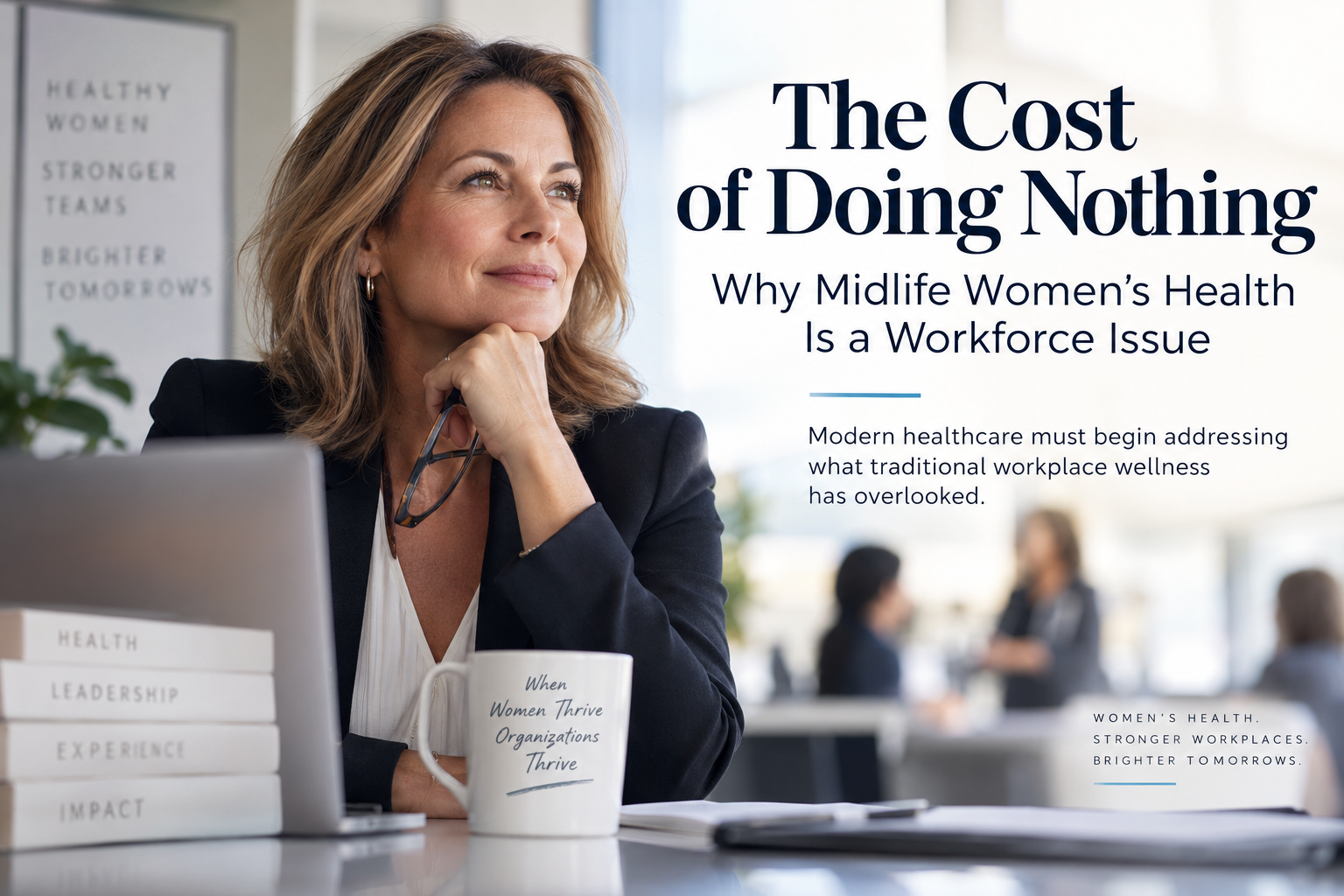
Modern healthcare and workplace wellness must begin addressing what they have overlooked for far too long.
For years, employers have invested heavily in workplace wellness with familiar goals: reduce healthcare costs, improve productivity, decrease absenteeism, prevent disease, and retain valuable employees. We count steps, offer biometric screenings, encourage exercise and stress management, and remind employees to complete annual physicals and preventive screenings. These efforts have value, but they also reveal a significant gap in how we think about women's health in the workplace.
We have made important progress in recognizing that women have specific health needs during pregnancy and postpartum. Employers increasingly understand that supporting women during these stages can influence health, attendance, engagement, and retention. Yet somewhere after the childbearing years, that intentional focus on women's health largely disappears. Women enter their 40s and 50s, often at the height of their professional experience, while simultaneously entering one of the most significant physiological transitions of their adult lives.
This is where HR, benefits, wellness, and organizational leaders need to pay attention. Midlife women are leading departments, managing teams, mentoring younger employees, caring for patients, making executive decisions, and carrying decades of institutional knowledge. They are not a marginal workforce population. In many organizations, they represent some of the most experienced and difficult-to-replace talent in the building.
At the same time, some of these women are navigating disrupted sleep, changing energy, hot flashes and night sweats, changes in mood, cognitive concerns, changes in body composition and metabolism, and a stress response that may feel very different from what they experienced a decade earlier. The challenge is that these changes do not always arrive together, and they do not necessarily announce themselves as perimenopause.
The Midlife Transition Can Be Difficult to Recognize
One of the reasons midlife women's health remains so poorly addressed is that perimenopause can be confusing. Many women still associate menopause primarily with hot flashes and the end of menstrual periods. In reality, the transition can begin years before the final menstrual period, and symptoms vary considerably from one woman to another.
A woman may still be menstruating regularly and begin noticing that she no longer sleeps through the night. She may struggle to retrieve words as quickly as she once did, feel unusually exhausted in the afternoon, notice changes in her body despite maintaining the same habits, or find that stress seems harder to tolerate and recover from. Another woman may experience anxiety, mood changes, headaches, palpitations, night sweats, or changes in her menstrual cycle. None of these symptoms should automatically be attributed to hormones, because other medical conditions can cause similar concerns and appropriate evaluation matters. But women also need enough education to recognize that the hormonal transition of midlife may be part of the conversation.
This is particularly important during perimenopause because ovarian hormone production can fluctuate rather than simply decline in a predictable, linear fashion. A woman may have a good month followed by a terrible month. She may assume she needs to work harder, sleep more, eat less, exercise more, or simply tolerate what she is experiencing. She may not connect the dots, and neither may the people around her.
From a workforce perspective, this matters because the earliest organizational impact may not look like absenteeism at all. It may look like a highly capable woman working increasingly hard to maintain the same level of performance while quietly wondering why everything suddenly feels more difficult.
The Economic Data Are Becoming Difficult to Ignore
The growing body of workforce research suggests that this is not simply an individual health issue. A 2023 Mayo Clinic study involving 4,440 employed women ages 45–60 estimated that menopause symptoms account for approximately $1.8 billion in lost work time annually in the United States. When medical expenses were included, the estimated annual economic impact reached $26.6 billion. In that study, 13.4% of participants reported at least one adverse work outcome related to menopause symptoms, while 10.8% reported missing work because of their symptoms.
Those numbers should capture the attention of healthcare leaders, human resource executives, benefits professionals, and anyone responsible for workforce strategy. At the same time, they need to be interpreted appropriately. The study population was predominantly White and was drawn from women receiving primary care through Mayo Clinic sites, and the researchers noted the need for larger and more diverse studies. The numbers should not be used to suggest that every midlife woman experiences workplace impairment. They demonstrate something more important: for a meaningful subset of women, symptoms can become significant enough to affect work.
Earlier U.S. research also found higher medical, pharmacy, and sick-leave costs among employed women diagnosed with menopause symptoms compared with matched controls. Researchers reported lower measured productivity in the diagnosed group as well. Taken together, these studies raise an important question for employers: how much of the cost associated with midlife health is already being absorbed without ever being identified as a women's health issue?
Sleep provides an especially useful example. Midlife sleep disruption can arise for many reasons, but it is also commonly reported during the menopause transition. Research using data from the U.S. Study of Women's Health Across the Nation found an association between new-onset sleep disturbances and employment outcomes among working midlife women. The researchers estimated approximately $2.2 billion annually in lost productivity associated with new-onset sleep disturbances among U.S. women ages 42–64. As with much of the emerging research in this area, the study was observational and has important limitations. It does not prove that sleep disturbance caused women to leave employment. What it does demonstrate is that sleep in midlife deserves to be taken seriously as both a health issue and a potential workforce issue.
The Cost May Be Hiding in Plain Sight
Traditional workforce metrics tend to capture what happens after a problem has become visible. Organizations measure absenteeism, healthcare utilization, engagement, disability, turnover, and recruitment costs. Those numbers are important, but they may miss what happens months or even years before an experienced employee finally appears on one of those reports.
Consider the woman who has not slept well for months but continues to manage a department. Her concentration is not as sharp as it once was, her energy drops dramatically in the afternoon, and she notices that she is working harder to accomplish tasks that previously felt routine. Perhaps she is also caring for aging parents, raising teenagers, managing a household, or carrying significant leadership responsibilities. She does not necessarily call in sick. She continues showing up, attending meetings, caring for patients, answering emails, making decisions, and meeting deadlines.
Because she is still producing, the organization may never recognize what is happening.
This is where presenteeism becomes important. Productivity loss does not always occur because an employee is absent. Sometimes an employee remains at work while functioning below her usual capacity or expending substantially more effort to maintain it. In the case of a highly experienced employee, that struggle may remain invisible for a long time because experience itself helps her compensate.
Eventually, however, something may give. She reduces her hours, turns down a leadership opportunity, begins using more sick time, decides she can no longer tolerate the demands of her position, or leaves altogether. At that point, an organization may classify the outcome as burnout, turnover, retirement, or a personal decision without ever asking whether health played a role.
That is why the cost of doing nothing can be so difficult to calculate. It is scattered across multiple workforce metrics rather than appearing neatly on a financial statement labeled midlife women's health.
Midlife Women Are Not the Problem. Losing Their Experience Is.
This conversation must be approached carefully because the last thing women need is another reason for employers to view age or female biology as a professional disadvantage. Not every woman experiences significant symptoms during perimenopause or menopause, and women should never be presumed less capable because of their age or reproductive stage.
The purpose of addressing midlife women's health is exactly the opposite. These women may represent some of an organization's strongest assets. They carry leadership experience, professional judgment, relationships, specialized knowledge, and institutional memory that can take decades to develop. Replacing that experience is neither easy nor inexpensive.
We have already recognized the importance of supporting women through pregnancy and postpartum because those health transitions can intersect with work. That progress should not stop when the childbearing years end. Women's health continues to change across the lifespan, and supporting women through midlife should be viewed as part of the same continuum.
For HR and wellness leaders, that requires a shift in perspective. The question is not simply, Should we offer a menopause benefit? The better question is, Do we understand the health needs of experienced women well enough to create a workplace where they can continue to perform, lead, and remain?
Workplace Wellness Needs to Evolve With Women
A comprehensive midlife women's health strategy should also be broader than menopause alone. Hormonal changes occur within a much larger physiological and lifestyle picture that includes sleep, nutrition, muscle and bone health, metabolic health, cardiovascular risk, stress and recovery, cognitive concerns, and healthcare literacy. Women also need to understand when symptoms warrant further medical evaluation rather than assuming everything they experience is hormonal.
This is one of the limitations of generalized wellness programming. Telling a 48-year-old woman to increase her daily steps is not the same as helping her understand the importance of maintaining muscle mass and bone health as she ages. Offering a generic stress-management webinar is not the same as teaching her how sleep, recovery, life demands, and changing physiology can intersect. Encouraging annual preventive care is important, but an annual physical alone does not guarantee that a woman understands what is changing or knows what questions to ask when she no longer feels like herself.
Education can help bridge that gap without turning the employer into the healthcare provider. Employers should not diagnose menopause, interpret laboratory results, recommend hormone therapy, or insert themselves into private medical decisions. Those decisions belong between a woman and her qualified healthcare professional. The employer's role is to create access to credible education, appropriate resources, informed leadership, and a workplace culture where women can seek support without being forced to disclose private medical information.
This distinction is especially important in healthcare systems. Nurses, nurse managers, clinical leaders, administrators, and executives can spend decades caring for other people while receiving surprisingly little education about their own changing health. A nurse may recognize the symptoms of dozens of diseases in her patients and still not understand why she suddenly cannot sleep, cannot recover from stress in the same way, or no longer recognizes how her own body is responding. Healthcare organizations have an opportunity to address that disconnect within their own workforce.
The Conversation for HR and Wellness Leaders Needs to Change
A keynote or workshop can begin this conversation, but meaningful change cannot depend entirely on bringing in an outside speaker once a year. Organizations need sustainable ways to understand what women are experiencing, provide credible education throughout the year, equip internal leaders and champions, evaluate existing benefits and wellness resources, and connect employees with qualified healthcare resources when their needs extend beyond workplace education.
That does not mean every employer needs to create a large menopause program. It means organizations with a significant population of women in midlife should understand whether their current workforce strategy reflects the realities of the people they are trying to retain.
HR, benefits, and wellness leaders should be asking whether midlife women understand the changes that can occur during perimenopause and menopause, whether managers have enough knowledge to respond appropriately without crossing into medical territory, and whether current wellness programs actually address women's needs across the lifespan. They should also examine whether they are measuring absenteeism while overlooking presenteeism and whether experienced women are quietly compensating for health challenges until they reach the point of burnout, reduced hours, career changes, or departure.
Most importantly, organizations should begin asking a question that has been missing from the workplace wellness conversation: What are we already paying for because we have not addressed this?
The financial impact of midlife women's health does not begin when an organization decides to fund a women's health initiative. Some organizations may already be absorbing those costs through healthcare utilization, lost work time, reduced productivity, turnover, recruitment, and the loss of experienced employees. The opportunity is to determine whether some of that investment can be redirected upstream toward education, prevention, appropriate support, and better access to resources.
We have spent years learning how to better support women as they enter motherhood. It is time to bring the same level of attention to another major transition in women's lives—not because midlife women are a problem to solve, but because their health, experience, leadership, and continued contribution are worth preserving.
This is not about accommodating weakness. It is about preserving strength.
For HR, benefits, and wellness leaders, midlife women's health should no longer sit at the edge of the wellness conversation. It belongs in discussions about workforce health, leadership development, retention, benefits strategy, and organizational performance.
Women's health isn't just a healthcare issue. It's a workforce strategy. When women thrive, organizations thrive.
Start the Conversation in Your Workplace
If your organization is beginning to ask what better support for midlife women could look like, I welcome the conversation. Together, we can look at what your female workforce may be experiencing, where your current wellness strategy may be leaving gaps, and what meaningful education and support could look like within your organization.
Let’s start the conversation about women’s health in your workplace.
Marcia Jones, NP
Women’s Health Expert | Speaker | Workforce Health Strategist
Women’s Health. Modern Healthcare. Stronger Workplaces.

Marcia Jones, NP is a women’s health expert, author and speaker with more than 30 years in healthcare. She partners with organizations to bring modern women’s health education into the workplace, helping women protect their health and potential through midlife while helping employers strengthen and retain an experienced female workforce.