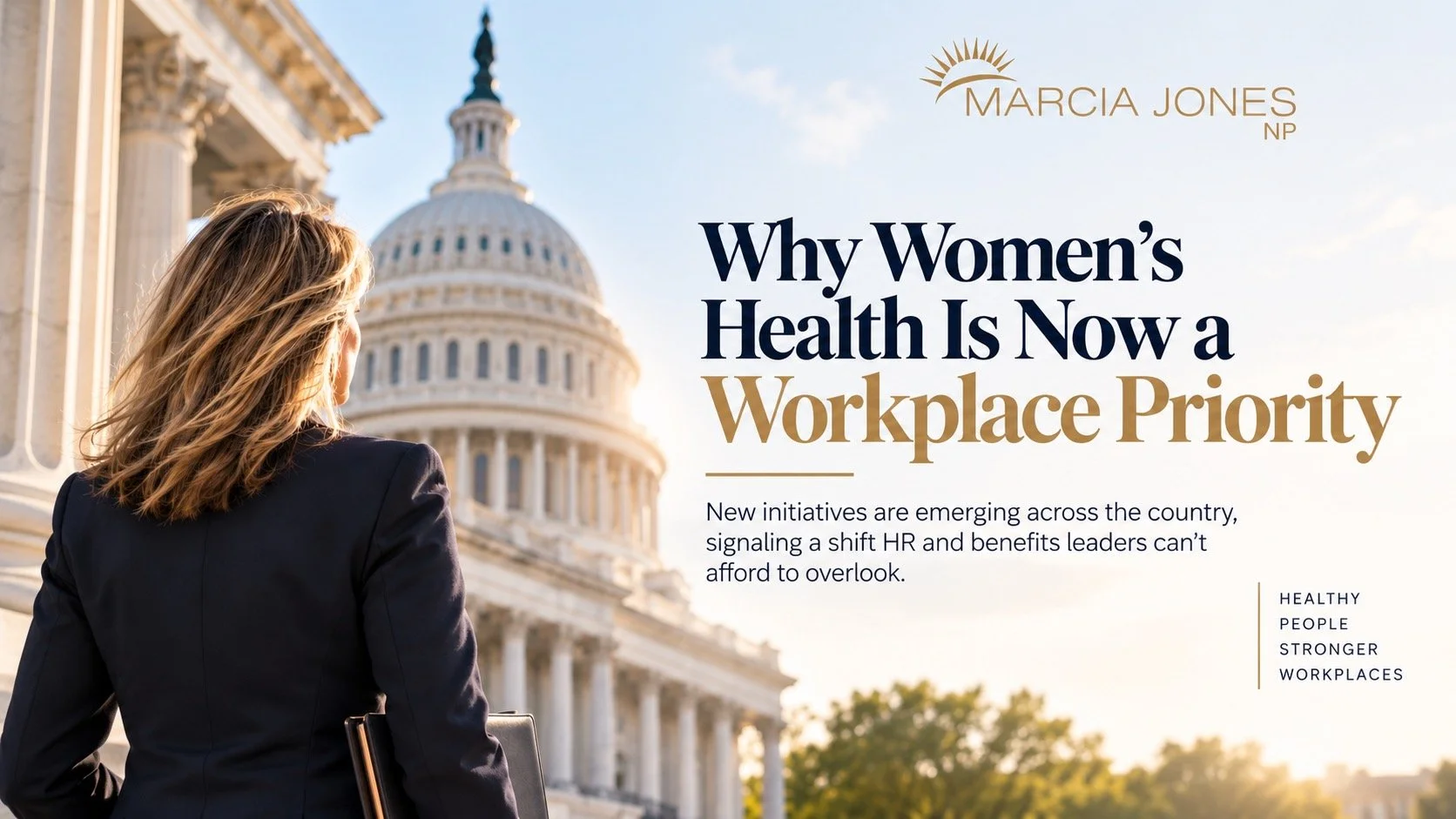
Why Women’s Health Is Now a Workplace Priority
Women’s Health Is Entering the Workplace: Why HR and Benefits Leaders Should Be Paying Attention
Across the country, women’s health is moving from a private conversation to a workforce conversation—and employers have an opportunity to get ahead of it.
For decades, workplace health benefits have addressed many of the predictable health needs employees experience throughout their careers. Pregnancy, parental leave, preventive care, mental health, chronic disease management and wellness have all gradually found their way into benefits strategies and workplace policies.
Yet one significant stage of a woman’s life has remained largely absent: midlife.
That is beginning to change.
Across the United States, employers, state governments, policymakers and benefits leaders are beginning to recognize that perimenopause and menopause are not simply personal health issues women should be expected to manage quietly outside the workplace. They can affect sleep, energy, concentration, mood, metabolic health and overall well-being during the same years many women are reaching the height of their professional experience.
And the movement is accelerating.
States Are Beginning to Act
Michigan offers one of the clearest examples of what may be coming.
In March 2026, the Michigan Women’s Commission released its Menopause Memorandum following a statewide initiative that included community conversations, workplace surveys and input from more than 2,500 women. The commission specifically recommended that employers educate employees about perimenopause and menopause, provide trusted resources, review workplace policies and benefits through a midlife women’s health lens, consider low-cost accommodations, and provide menopause-awareness training for supervisors and HR professionals.
Michigan's approach is especially important for HR leaders because it moves the issue beyond healthcare alone. The state's recommendations explicitly connect menopause with workforce participation, retention and economic growth.
Other states are moving in similar directions, although the approaches differ.
New York currently has proposed legislation that would require employers to provide at least five days of leave during a 12-month period for employees experiencing menopause symptoms and would direct the state to develop menopause-related workplace guidance. Separate proposed legislation addresses discrimination and awareness of employee rights involving menstrual, perimenopausal and menopausal conditions. These proposals remain in committee as of September 2026, so they are not current employer mandates—but their introduction demonstrates how quickly the policy conversation is developing.
Massachusetts is also considering significant legislation addressing perimenopause and menopause care. A current bill would establish a commission to examine access to care, insurance coverage, medical education and the impact of menopause on the workforce. Earlier versions also included substantial workplace provisions addressing accommodations and discrimination.
Rhode Island has gone further. Its employment protections were expanded to include menopause-related conditions, making workplace accommodations part of the conversation rather than simply an optional wellness initiative. SHRM now identifies Rhode Island as the first state to mandate employer menopause accommodations, while other states are addressing menopause through insurance coverage and related health policy.
What we are seeing is not one uniform national mandate. It is something employers should arguably pay just as much attention to: a pattern.
Employers Are Moving Too
Government is not the only place this shift is occurring.
According to SHRM's 2026 Employee Benefits Study, 27% of employers now offer menopause support or resources, up from 18% the previous year. The study included 5,472 organizations. Benefits can include access to menopause specialists, hormone therapy coverage, pelvic-floor care, education and menopause-specific leave.
That is a significant increase in a single year.
Major employers are already incorporating midlife health into their benefit strategies. Bank of America, for example, provides eligible employees and covered family members with menopause and midlife health support that includes access to providers, educational resources and peer communities.
This is how workplace benefits often evolve. What initially appears to be a specialized benefit begins gaining attention as employers recognize the workforce affected, employees begin asking for support, evidence accumulates and policymakers become involved.
We have seen similar evolutions with mental health benefits, fertility coverage, parental leave and caregiver support.
Women’s midlife health appears to be entering that same conversation.
Why HR Leaders Should Care Before They Are Required To
The business case deserves attention.
A Mayo Clinic study estimated that menopause symptoms are associated with approximately $1.8 billion annually in lost work time in the United States and $26.6 billion when medical expenses are included.
More recent research reinforces the connection between women's health and their careers. Gallup and Pivotal reported in September 2026 that more than 40% of U.S. women surveyed said their health had limited their careers in some way. Among women who were unable to get the healthcare they needed, that number increased to 66%.
This matters because the women experiencing midlife health changes are often not at the beginning of their careers.
They may be department heads, nurses, managers, executives, educators, engineers, clinicians, supervisors and senior professionals. They carry relationships, expertise, leadership ability and institutional knowledge that may have taken organizations decades to develop.
When one of these women reduces her hours, turns down a promotion, steps away from leadership or leaves an organization entirely, the employer does not simply lose an employee.
It may lose experience that is difficult and expensive to replace.
This Is Bigger Than Adding a Menopause Benefit
There is another important distinction HR and benefits leaders should understand.
Addressing women's health in the workplace should not simply mean purchasing another benefit and adding it to an employee portal.
A company can technically offer menopause support while employees remain unaware it exists, managers do not understand the issue, workplace culture discourages women from discussing health concerns, and the organization's existing policies unintentionally create barriers.
Bank of America research previously found that 64% of working women wanted menopause-specific benefits, while only 14% believed their employers recognized the need. Even where benefits existed, awareness and utilization remained low.
That gap is important.
The next generation of women's workplace health requires more than a benefit. It requires education, culture, benefits, leadership awareness and practical workplace support working together.
That does not mean employers should diagnose women, practice medicine in the workplace or create policies that single women out.
It means organizations can understand a predictable health transition affecting a meaningful portion of their workforce and ensure their systems are prepared to support employees appropriately.
Being Proactive Is the Opportunity
For HR and benefits leaders, the question should not simply be:
“Are we legally required to do this yet?”
A better question is:
“Is our organization prepared for where women's health and workplace expectations are heading?”
Forward-thinking organizations have an opportunity to examine their benefits before employees discover gaps themselves. They can educate managers before uncomfortable situations occur. They can assess whether women actually know how to access the resources already available to them. They can identify simple accommodations that may help an experienced employee continue performing at a high level rather than quietly struggling.
And they can listen.
The employers that approach this thoughtfully are not lowering performance expectations for women. They are recognizing that supporting health can help experienced women continue meeting those expectations.
That is an important distinction.
Women’s Health Is Becoming a Workforce Strategy
For years, menopause was largely treated as something women dealt with privately.
That era is changing.
States are studying it. Legislatures are introducing bills. Employers are expanding benefits. HR organizations are tracking menopause support as an emerging benefits category. Women themselves are increasingly asking why such a predictable stage of life has been almost invisible within workplace health strategies.
This should be on the radar of every HR leader, benefits director and executive responsible for workforce planning.
Not because every organization needs to implement the same program.
Not because every woman experiences midlife in the same way.
And not simply because legislation may be coming.
It matters because organizations invest enormous resources in recruiting, developing and retaining talented people. Ignoring a health transition affecting experienced women during some of their most valuable professional years is increasingly difficult to reconcile with that investment.
Women’s health isn’t just a healthcare issue. It’s a workforce strategy. When women thrive, organizations thrive.
Is Your Workplace Ready?
Organizations do not have to wait for legislation or a retention problem to begin this conversation.
I work with organizations to assess how well their current benefits, workplace culture, leadership education and employee resources support women through midlife—and to identify practical opportunities for improvement.
If women’s health is not yet part of your workforce strategy, now is an excellent time to start the conversation.
Invite me into the conversation at your organization.
Marcia Jones, NP is a women’s health expert, speaker and creator of the U.N.I.Q.U.E. Woman Workforce Method™, helping organizations address the overlooked health challenges of midlife and create workplaces where experienced women can continue to thrive.

Marcia Jones, NP is a women’s health expert, author and speaker with more than 30 years in healthcare. She partners with organizations to bring modern women’s health education into the workplace, helping women protect their health and potential through midlife while helping employers strengthen and retain an experienced female workforce.